Ah, yes: Catholic devotionalism. Where would we be without it? This is the tradition spurned as "superstitious" by generations of Protestants as well as the past fifty-odd years of Catholic liturgical scholars. The "Spiritual But Not Religious" crowd sees a vast wasteland of rules, regulations, social conformism, and external authority. Classrooms of undergraduate students dismiss Catholic devotional practices as repetitive, going-through-the-motions, and inauthentic. (But, curiously, have no problem ascribing reality and authenticity to phenomena like the Duggar family's particular [and particularly narrow] evangelicalism, the Peoples Temple suicides, and the Creation Museum. But I digress...) My faculty colleagues, some of whom are ex-Catholics, harbor nothing but contempt for the old ways, that of their oppressive parents and grandparents. Even St. Josemaria Escriva castigates mindless recitation of the Rosary (Furrow #477). At one level, it must be admitted, they have a point.
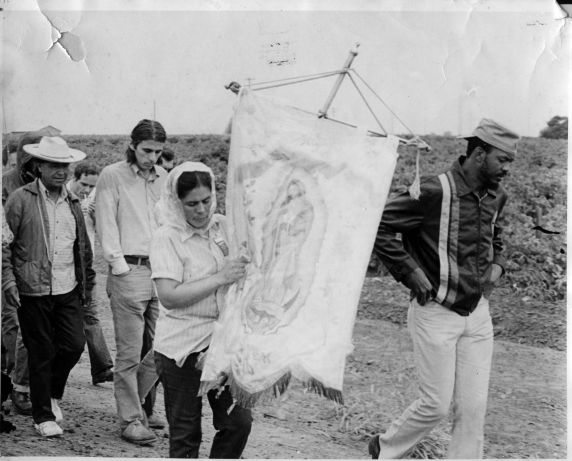
On the other hand, Catholic devotionalism is an irreducible part of American Catholic history and varieties of Catholic social and spiritual identity. A sine qua non--without it you really don't have anything "Catholic." Consider: Caesar Chavez's invocation of Our Lady of Guadalupe in his organization of migrant farm workers:
Source: Wayne State Library
Pope John Paul II, then Cardinal Karol Wojtyla, leading peaceful and popular resistance to Polish Communism:
Personal aside: I love this photo's contrast between the vast crowd's vivid colors and the drab backdrop of Soviet-style housing. How many divisions does the Pope have?
Galen Erso and Father Rodrigues face the same dilemma: How do you resist silently?
Answer: They respond differently. Galen actually does something. Depending on the book or the movie, Rodrigues does little or nothing. But at the moment of decision, they face the same demoralizing, annihilating reality: they can resist immediately and surely suffer, or they can submit outwardly and seek another avenue of resistance.
Not only that but Democratic party leaders created their own Catholic advocacy groups to foment their changes from within the Church. Catholics in Alliance for the Common Good? Yep. Catholics United? Yep, them, too. Let's repeat that: these groups were created to bring about change within the Catholic Church--changes that corresponded nicely to mainstream Democratic Party politics. Let that sink in.
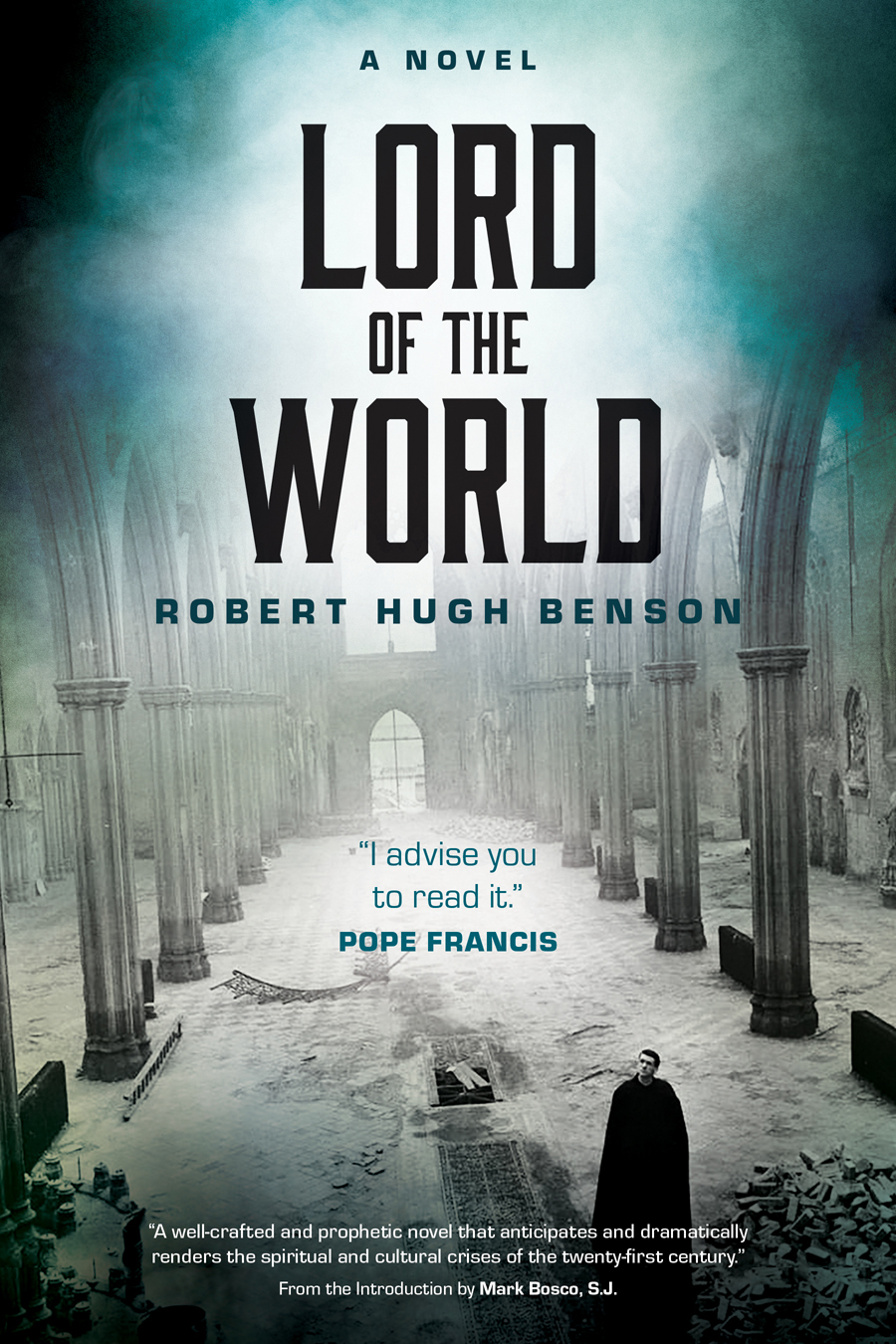
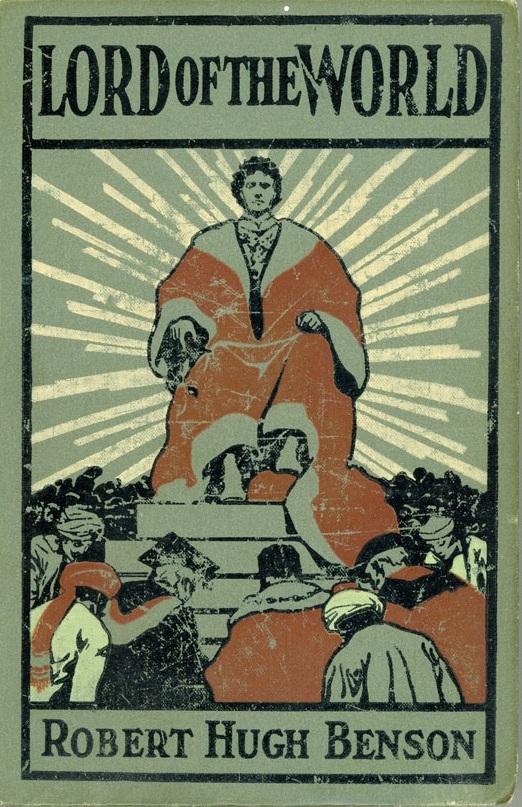
Blogger note: Just recently this blog took on discrepancies between Tim Kaine's political stances and his affirmation of his Catholic faith. This post, working from material composed earlier this year, provides balance with a critical view of the Trump campaign. Robert Hughes Benson's Lord of the World. Folks, you need to read this book. It matters not that the book was published in 1907, the same year as St. Pius X's Pascendi, five years before the Titanic sank, seven years before Gavrilo Princip shot Archduke Ferdinand, thirty-two years before Hitler invaded Poland. The novel features euthanasia, the loss of religious liberty, anti-Catholicism (because they're two different things), globalization, total war, martyrdom, demagoguery, and the miraculous. Bradley Birzer, author of illuminating studies of Christopher Dawson and Tolkien, earlier this year posted this brief article at The Imaginative Conservative. I myself was reminded about Benson and this particular novel by this Crux article by John Allen, Jr. Both Benedict XVI and Francis have recommended the book. Benson (1868-1914), whose father had been Archbishop of Canterbury, was a celebrity convert and priest. Once quite popular among English-reading Catholics, his reputation has vanished since the Second Vatican Council. Lord of the World follows the parallel trajectories of Father Percy and his doppelganger, Julian Felsenburgh, a senator from Vermont (no, I am not making that up) who is clearly the anti-Christ. Secularism has pushed all religion to the fringes as the masses chose instead this world's pleasures (euthanasia and what amounts to physician-assisted suicide are readily available). Only Rome the city itself resists as it has, through international treaty, become the sole earthly haven for Catholics. Martyrdom awaits any Catholic who dares declare the Faith openly. Meanwhile a worship of divinized earthly powers spreads like wildfire. Amassing this new awakening, and yet remaining above it all, stands Julian Felsenburgh. Traveling across the world at record speeds, Felsenburgh successfully unites the entire planet, save Rome, under one government. Meanwhile, Father Percy sees his clerical friends lose their faith and the Church lose even what little it retains on earth. The impending victory of Felsenburgh's atheist materialism seems complete. The conclusion, though, must be read all the way to its very last words. No spoilers here. (Pic credits: Ave Maria Press & Wikipedia)
This past Friday, May 13th, was the 224th birthday of Blessed Pope Pius IX (Giovanni Mastai-Ferretti), Bishop of Rome from 1846 until 1878. In a bizarre string of coincidences, the likes of which religion geeks like me love and everybody else (perhaps wisely) just overlooks, May 13th is also: * the anniversary of the Blessed Mother's appearance to the children at Fatima, Portugal (1917) * the birthday of Peoples Temple founder, Jim Jones (1931-1978)--yes, the purple Kool-Aid guy and... * the 35th anniversary of the attempted assassination of St. John Paul II by Mehmet Ali Agca. The Fatima and assassination events are connected. We now know that St. John Paul, as his driver whisked him away to the hospital, uttered "And now we see the Third Secret of Fatima revealed...", referencing the three messages Our Lady revealed to the three children in May 1917. The third secret, revealed only in 2000, included a vision of white-clad bishop being murdered amidst a crowd. John L. Allen, Jr. notes that St. John Paul firmly believed Our Lady of Fatima altered the shot's trajectory and saved his life. Agca's bullet now resides in the crown of Our Lady's statue in Fatima itself. Allen:
Consider the worldview at work here: John Paul II was profoundly convinced that on May 13, 1981, the Virgin Mary altered the flight path of a bullet in order to keep him alive and, in so doing, to preserve his papacy.
If you genuinely believe that Mary interceded with God in order to suspend the laws of physics to keep you in office, then you never just wake up one morning and decide you’ve had enough.
Recall that John Paul II, even before the assassination attempt, regarded his papacy as belonging to Mary, not to him, as expressed in his motto Totus Tuus, “Entirely Yours,” a line drawn from the spiritual works of Saint Louis de Montfort.
If ever the pontiff would have concluded that Mary had put an exclamation point on her rights of ownership, the day of the assassination attempt certainly was it.
In other words, John Paul II simply did not believe it was up to him to decide when it was over.
Read all of Allen's piece here. The profundity of St. John Paul's faith and his mystical-eschatological view of human history, including his own life (something Allen details in the post linked), stem from his own foundations in Marian piety and thus the Rosary. That is something St. John Paul's predecessors, particularly Pius IX and Leo XIII, knew quite well. Leo wrote twelve encyclicals on the Rosary alone. Pius' Marian devotion was perhaps a bit more embodied.
Checking this blog's stats and for the first time EVER, there are more reader hits from a country other than the United States. Currently this blog's greatest activity comes from....BRUNEI.
At this point it is important to remember this story in the news. Brunei is run according to Sharia law, and thus allowed Christmas celebrations. This year, though, the public celebration thereof was judged to threaten the beliefs of Brunei's majority population. Public expressions of Christmas, i.e., Christianity, including crosses and decorations (at this point someone should perhaps inform Brunei's sultan that a cross is not a Christmas decoration) will be strictly banned.
So, if those in Brunei reading this blog are Christians (Catholic or not) restrained by this legislation, know that this blog appreciates your interest and prays for your faith, your well-being, and a very merry Christmas.
As St. John Paul II repeated, Be Not Afraid! Never, ever give up hope.
...because sometimes enough is enough. Here's a recent Rod Dreher post at The American Conservative. Dreher's reading audience must number in the thousands for it surely displays a wide diversity of perspectives. Thus many of Dreher's posts involve letters/emails from his readers. This involves a woman explaining her re-conversion to Roman Catholicism. The light begins to shine when she confronts the unavoidable ridiculousness that characterizes much of modern thought regarding gender.
At that moment my lifelong assumption of a culture of shared Logos
was shattered. I wish I had said something obvious, but I was mute -– it
felt as if we were suddenly all thrust into a bizarre alternate reality
where even one’s identity as a male or female was subject to erasure by
a ham-fisted cultural elite.
I thought about this incident for days. I was shocked to the core
that a well-educated person of some importance in academia could say
something that, at least on the face of it, appeared not only
nonsensical, but deeply threatening to human dignity and freedom.
Thus, one either succumbs to the madness, or returns to church to take a stand.
At the end Dreher's reader concludes:
Orthodox Christianity and Catholicism contain a vast profusion of
ideas over a span of two thousand years – ideas of God, Heaven and Hell,
the purpose of life, art, beauty, social good, and human
exceptionalism, excellence, and nobility.
Orthodox Christianity is a vast room filled to overflowing with a
profusion of inexhaustible gifts. Protestantism appeals more, perhaps,
to the need of Americans for a simplified approach, a streamlined
emphasis on the Gospel as opposed to history, art, and the whole
mysterious drama of the saints depicted within the walls of cathedrals.
Usually Dreher contributes his own copious, insightful commentary. Readers know how much I appreciate Rod's writing and arguments, so it's interesting to see him here grant the entire space to his contributor. As usual there is much to contemplate there: the recognized regret of failed action, realized new convictions, appreciation for the broader traditions around us, and rediscovering a spiritual home that stands ready to welcome us all home...even if we might be newcomers (as Dreher and I are). Read it all here. Reading this post made me think not of rants against American academic foibles, nor accelerating cultural/spiritual rot, nor more rhapsodic reminders that "beauty will save the world" (although it will--never doubt that). Oh no. This reminded me immediately of my beloved Wabash College. Wabash archivist Beth Swift provides the full story here. Back in the Victorian days as the American college experience as we know it in the 20th and 21st centuries emerged, the Wabash student body--which was and remains proudly all-male--gathered to discuss the College's sports teams. One student suggested heliotrope:
At this point--much like Dreher's contributor above wished she had done--another student hopped up and shouted: "Heliotrope, hell! We want blood! So, Scarlet it is." Like all great narrative traditions--and don't be mistaken, attending a college is participation in a narrative tradition...our place, our teams, our rituals, etc--Wabash has celebrated this ever since. Perhaps wisely Bill Placher did not mention this when gently guiding a bunch of 19-year-old boys/men through Alice Walker's The Color Purple in 1989. Furthermore, given what has transpired in gender and sexual politics, one can scarcely imagine what Wabash would be like today if it remained all-male with its sports teams decked out in heliotrope. Thank God a few years later, inspired by the scarlet-clad teams, two Wabash graduates penned Dear Old Wabash, the nation's longest college fight song. A musical and lyrical challenge, the song celebrates scarlet, the "gorgeous dye of the color we love so well."
It's not merely "red," just as heliotrope isn't merely "purple." The song, like the story that gave rise to it, also represents a choice--and a choice that's decisive, celebratory, and inspiring. Are there other teams and schools that wear red, even scarlet? Of course, but in this story it is ours. This identification, this line demarcating 'us,' resonates behind Dreher and his contributor who confronted the spiritual and intellectual abyss that modern academic life seems content to throw itself into. Pulling us back from the line is the apostolic Christian tradition--Catholic and Orthodox--whose multivalent resources offer so many points of contact. True, Americans might prefer, at least initially, the simpler explanations of evangelical Protestantism, but too much simple sugar can very easily lead to type II diabetes...and simplistic spirituality and/or unwitting intellectual pride can often lead to spiritual diabetes.



 Galen Erso
  Father Rodrigues