
Ah, yes: Catholic devotionalism. Where would we be without it?
This is the tradition spurned as "superstitious" by generations of Protestants as well as the past fifty-odd years of Catholic liturgical scholars. The "Spiritual But Not Religious" crowd sees a vast wasteland of rules, regulations, social conformism, and external authority. Classrooms of undergraduate students dismiss Catholic devotional practices as repetitive, going-through-the-motions, and inauthentic. (But, curiously, have no problem ascribing reality and authenticity to phenomena like the Duggar family's particular [and particularly narrow] evangelicalism, the Peoples Temple suicides, and the Creation Museum. But I digress...) My faculty colleagues, some of whom are ex-Catholics, harbor nothing but contempt for the old ways, that of their oppressive parents and grandparents. Even St. Josemaria Escriva castigates mindless recitation of the Rosary (Furrow #477).
At one level, it must be admitted, they have a point.
On the other hand, Catholic devotionalism is an irreducible part of American Catholic history and varieties of Catholic social and spiritual identity. A sine qua non--without it you really don't have anything "Catholic." Consider:
Caesar Chavez's invocation of Our Lady of Guadalupe in his organization of migrant farm workers:
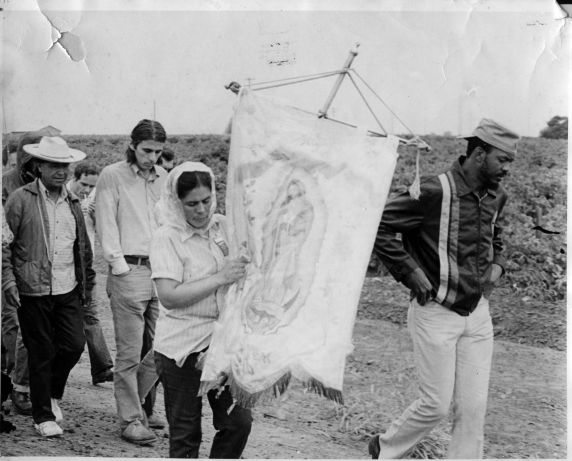
Source: Wayne State Library
Pope John Paul II, then Cardinal Karol Wojtyla, leading peaceful and popular resistance to Polish Communism:

Source: nd.edu on Pinterest -- St. John Paul II's 1980 visit.
Personal aside: I love this photo's contrast between the vast crowd's vivid colors and the drab backdrop of Soviet-style housing. How many divisions does the Pope have?
