Seeking the proverbial "canary in the coal mine" regarding the academic study of religion and theology? Look no further at the job offerings. You might want to pour a good, strong drink before you do.
Here, as of April 17, 2019, were some campus ministry positions open:
Notice: lots of Catholic institutions listed. Also, an Ivy League, a Lutheran college, and a couple west-coast private, non-affiliated institutions.
So far so good. There's a job market, which means there's a demand.
"Because talking fast, without pausing for reflection, is only noise..." St. Josemaria Escriva, The Way #85
Thursday, June 6, 2019
Friday, March 22, 2019
+1 in celebration of Google +
Google will eliminate its Google + social media platform on April 2, 2019.
The under-used platform never came close to competing with Facebook as a social media to MySpace (which, interestingly enough, still survives, albeit known only when it inadvertently erases almost a decade of material). Google + became something of a joke as Facebook, then Twitter, then Instagram, then SnapChat rocketed in popularity.

source: searchengineland.com
No, for everything Google has done right, Google + faltered.
Since it's going away forever, though, a certain celebration seems in order. Google + might have been awkward and largely unknown, but it was not without its own virtues. Unlike Facebook or Twitter, you could participate in different degrees in a wide variety of online groups. Obviously, religion is one example. As this blog started in 2012, I found several, not just one, audiences on Google+. Many of the 2012-2015 posts appeared simultaneously on the "Catholic Blogs," "Roman Catholics," "Living the Catholic Faith," and occasionally "Theology of the Body" groups. The G+ Catholic Blogs even had a Twitter handle (no longer active). On any given day posts on these groups might range from the overly wordy and wonky like my own to mainstream/leaning conservative spirituality to frankly sympathetic sedevacantism or equally unapologetic left-wing beads-n-sandals Catholics. And those were just the Catholics. There were evangelical Protestants of all sorts, Hindus, Buddhists, progressive politics, and conservatives who revered Steve Bannon. Also, unlike the more popular platforms, it seemed easier to connect with earnest international Catholic participants. Google + seemed to be a gateway platform where many gained their sea legs before moving to the more popular ones.
Perhaps because so few comparatively used the platform, Google + was never monitored as Facebook and Twitter justifiably have been. At any rate, a certain diversity of voices existed among Catholic use of Google +, much like what exists on #CatholicTwitter today.
Wednesday, February 27, 2019
Waiting in line at Tyburn
On Feb. 27, 1601, three Catholics were executed at Tyburn for the crimes of priesthood (i.e., being a Catholic priest) and harboring priests. Anne Line, a convert from Puritanism and found guilty of hosting one priest, was executed by hanging. Then, one by one, the priests died in a far more horrible manner.
I'll be honest: the past several months have not been easy. Problems at all levels--professional, personal, national, ecclesial--have proliferated and intensified. Yet the final, awful culmination of these problems always seems forestalled. We can see a horrendous conclusion looming, yet we are forced into being spectators to our own demise.
Yes, I know: The Book of Job
But anybody who reads this blog probably knows the vacuity of that answer, or at least the superficial use thereof. Job, despite what James 1:7 says, is not patient. I, like many who have taught an undergraduate course on the Bible, have squelched uncountable student flare-ups over this denial.
Job serves a vital purpose by demonstrating that, contra facile readings, this complete annihilation of one's selfhood really sucks. This is especially true when your so-called 'friends' stand by nagging and not helping. And it should be laughable that stating that so requires so much language. Job's story, foreshadowing the Resurrection, concludes with the mystery that the suffering is not the final word. Our earthly existence might end in less-than-desirable circumstances, but that end is not *the* end. God's mystery unfathomably includes more than mere mortals can grasp. That is the point of Job--when God speaks out of the whirlwind, not Job enjoys material restitution.
So, yes, sometimes life does suck, but then there are other times when it's quite spectacular. THAT is life--the ebb and flow.
But not when you're apparently waiting in line at Tyburn. Lately it has not been the horrific experience itself but rather the dread anticipation knowing what is unavoidable. Tom Petty sings that "the waiting is the hardest part." Job and Tyburn substantiate this, but there's no way a nifty pop song summarizes such incipient agony.
Wednesday, July 18, 2018
Good Food is Not Enough
Celebrity chef, food writer, and CNN travel star Anthony Bourdain committed suicide Friday, June 9, 2018. His death came as a complete shock--its suddenness as well as the manner by which it came. Coupled with the suicide of celebrity handbag designer Kate Spade earlier the same week, Bourdain's death ignited a firestorm of discussion: signs of depression and suicide, what to say in conversation or public speaking events, the morality of taking one's life, etc.
Then Dusty Gates posted this in Crisis magazine: "Good Food is Not Enough."
A hard post--Gates doesn't shy away from some technical theological language, nor does he shy away from the reality that suicide is, at the bottom of it all, a failure. So several people I know, and for anybody reading this, perhaps you and several people you know, won't like it. I think that's fair. Still, Gates makes some good points worth considering. Gates:
Read it all here.
Then Dusty Gates posted this in Crisis magazine: "Good Food is Not Enough."
A hard post--Gates doesn't shy away from some technical theological language, nor does he shy away from the reality that suicide is, at the bottom of it all, a failure. So several people I know, and for anybody reading this, perhaps you and several people you know, won't like it. I think that's fair. Still, Gates makes some good points worth considering. Gates:
Another reason that Mr. Bourdain didn’t appear to be a man struggling with depression or despair is that he seemed to be truly in touch with goodness, in several concrete ways. He appreciated good food, good drink, good music, good scenery, good friends. He appreciated good culture, and thought it worth preserving and celebrating. He seemed to have a friend in each location he visited, and he appeared to truly relish the opportunity to sit with them, eat together, and talk. Maybe it was all a show, and they were just actors following a script. But it sure didn’t seem that way. Though sarcastic and critical, Bourdain left the impression of a man who placed value on the good things that the world had to offer. He seemed to advocate time and money being well spent on good and enjoyable things. There is still a big step left to be taken, however, between experiencing good things and experiencing goodness itself, and a supernatural bridge is needed to span the gap.
And an instance that might prompt some to take a step back:
St. Augustine gives us insight into the delicate balance in which beauty must be held by the human mind. His own interior battle with carnality and his resulting distrustful, questioning disposition towards the senses allow Augustine to guide us through a detailed description of how experiences of natural beauty and sensible goodness work upon a person’s intellect and will. His Confessions present us with a nuanced discussion of how things like food, art, and music are interpreted, and how they can move us (either towards or away from God), or, in other cases, appear to do nothing at all. Augustine considers, for example, the different affect which beauty has on the one who merely sees, and the one who sees and inquires: “Beauty appears in the same way to both beholders,” says Augustine, “but to one it is dumb, and to the other it speaks. Or rather, it speaks to all, but only they understand who test the voice heard outwardly against the truth within.”
In a reflection on the potential for creation to participate in the sole divinity of God, Augustine relates to his reader a vision he had of himself encountering a host of created things, and inquiring of each of them whether or not they were the rightful recipients of his love: “They denied me: ‘We are not the God you seek.’ And to all things which stood around the portals of my flesh I said, ‘Tell me of my God. You are not he, but tell me something of him.’ Then they lifted up their mighty voices and cried, ‘He made us.’ My questioning was my attentive spirit, and their reply, their beauty.”
Personally, I think St. Augustine's helpful in precisely these sorts of situations. It wasn't as if the Bishop of Hippo lived a soft, cushy life free of strains and anxieties. St. Augustine wrote so much about sin because he had sinned quite a lot already. He knew that of which he wrote. Still, I know St. Augustine often turns people off.
Here's the turn in Gates' argument:
Anthony Bourdain’s death was a reminder that good food is not enough. Good atmosphere, good conversation, and good meals can take us a long way towards joy. But they are never substitutes for joy. Those things only give us true joy if they are accompanied, or, perhaps more accurately, preceded by a relationship with the Lord who gives us all these good things, and provides them with their significance. Our God ought not be our stomachs, as St. Paul reminds us, as does Dante in his description of the poor souls in his Inferno. Chaucer’s Pardoner goes so far as to claim that gluttony is the root of all other sins. Our food might help us to be joyful and can lead us towards the higher goods, but only if we recognize that it is food for the journey—a mysterious foretaste of milk and honey like that of the Israelites in the desert—and not an end in itself.
Read it all here.
Labels:
Augustine,
celebrity culture,
Christian theology,
Christianity & violence,
Elizabeth Scalia,
faith,
Pelaganism,
Steve Webb,
suicide
Giddy
Recently my most active social media account has been Twitter. Please follow me here.
Usually, I'll admit, it's a bunch of retweets and funny/Catholic stuff. I tweet on the edges of "Catholic Twitter" and its subgroups "weird Catholic Twitter" and "Pierogi Twitter" (running afoul of this when I tweeted about Cornish pasties. I'll never make that mistake again!)
All of this to say: I don't make a big splash on Twitter.
Until earlier today when I retweeted some from Princeton professor Robert George about religious freedom. Then this happened:
WOOT WOOT! That' right, folks. He responded. My heart is a-flutter.
He's also right. Religious freedom is for everybody, and Christians should defend it for others as well as themselves. The original tweet involved Muslims being banned from a public pool here in the United States. This should not happen, ever, based on religion. Muslim, Sikh, Catholic, atheist, etc--everybody has the right to religious freedom.
That's one of the reasons why one of my favorite St. John Paul II quotes comes from Redemptoris Missio #39: "The Church proposes, she imposes nothing." In my pre-convert days I scoffed at that very line, and now it's one of my most favorite Catholic things. Funny what religious freedom can do...
Labels:
freedom,
John Paul II,
religion & culture,
Robert George,
Twitter
Wednesday, March 21, 2018
Embracing my own rejections
So, usually this blog cheers the Wojtylas, the Ratzingers, and the Extraordinary Form. TotB (Theology of the Body) and Gregorian chant. Mt. Carmel and Opus Dei. Not all of the usual right-wing Catholic stuff, but obviously some of it. ((mitigated by the Trump presidency!)) Oh yeah, and a bunch of 80s hard rock.
This post appeared in draft first during LENT, though, so let's instead this time feast on some of which this blog usually trashes: polyester pant suited nuns and moms, felt banners, schlocky "spirit of Vatican 2" songs, Communion in the hand, no kneelers, Paul Tillich, LBGTQ and the social construction of gender, bad 80s pop music, and fast food. In other words, all the things that cause, foment, exacerbate, and sustain spiritual diabetes, not that which, in my view, actually cures this spiritual malaise.
Why? These, too, are parts of God's creation. The Creed tells us this. We ask God to forgive our trespasses as we forgive those who trespass against us. Both Karl Barth and Romano Guardini remark on the remarkable presumption this request makes. Who are we--humans, part of creation--to bargain with God, the creator Himself? It makes no sense, and the extension of responsibility that this forgiveness we desire relies on the same which we extend to others.
https://twitter.com/postmoltmannian/status/647296279660236800 Moltmann thought Barth left nothing to say until future eschatology was too reductionistic.
So whether it's mainline Protestantism shrinking though it is with its goofy, inept evangelization:
Source: BadVestmentsBlog
This post appeared in draft first during LENT, though, so let's instead this time feast on some of which this blog usually trashes: polyester pant suited nuns and moms, felt banners, schlocky "spirit of Vatican 2" songs, Communion in the hand, no kneelers, Paul Tillich, LBGTQ and the social construction of gender, bad 80s pop music, and fast food. In other words, all the things that cause, foment, exacerbate, and sustain spiritual diabetes, not that which, in my view, actually cures this spiritual malaise.
Why? These, too, are parts of God's creation. The Creed tells us this. We ask God to forgive our trespasses as we forgive those who trespass against us. Both Karl Barth and Romano Guardini remark on the remarkable presumption this request makes. Who are we--humans, part of creation--to bargain with God, the creator Himself? It makes no sense, and the extension of responsibility that this forgiveness we desire relies on the same which we extend to others.
https://twitter.com/postmoltmannian/status/647296279660236800 Moltmann thought Barth left nothing to say until future eschatology was too reductionistic.
So whether it's mainline Protestantism shrinking though it is with its goofy, inept evangelization:

Source: BadVestmentsBlog
Friday, October 20, 2017
Super Caboodle is more like it, part I
Blogger's note: Further proof that the time between a post conceived and a post posted cannot be determined easily. Please enjoy anyway...
So Lady Gaga.
Yes, you just knew that eventually she would make an appearance on this blog. A Jesuit blogger posted this in 2016 as a reflection on mercy and pop music. And here she is singing "Perfect Illusion."
Scored a couple bonus points with my students by pointing out the Buddhist allusions here. "At least now I know...you were a perfect illusion."
Thursday, August 10, 2017
Are you bleeping kidding me?
A (melo?)drama in several acts...
Not for the topic itself but rather the level at which this discourse proceeded. Let's get it straight: one of the Pope's closest Jesuit buddies and an Argentinian Presbyterian minister hand-picked by Pope Francis himself to edit the Argentine version of L'Osservatore Romano, co-author a piece about ecumenical cooperation in a continent neither of them come from or live in. (Let's put aside for a second the rather curious fact that there's a Protestant minister playing a prominent role in disseminating a Catholic publication...) OK, got it--now what are the National League Central standings? On the surface it just doesn't seem like that big of a deal.
But you know where this story leads--of course it's a big deal. Spadaro and Figueroa waste no time in alleging a "ecumenism of hatred" between the two groups. Both harbor deep hostilities about modern life, seeking instead to reassert a baldly theocratic order wherein many elements of progress would be reversed. The authors mention Lyman Stewart's funding of The Fundamentals in 1910-5 (overlooking the complexity of this phenomenon) and John Rushdoony's Christian reconstructionism. These figures contribute to an apocalyptic world view wherein anything leading to dialogue is suspect and anything validating conflict with the forces of (modernist) evil are celebrated. The Scriptures say a big fight with evil is coming, so let's get to work, good guys. Spadaro and Figueroa finger George W. Bush as particularly susceptible to this thinking.
They then name Breitbart chairman and Trump cabinet strategist Steve Bannon as a fomenter of this "ecumenism of hatred." They seem unaware that Bannon's religiosity is questionable or that in 2014 Bannon gave a now-well-publicized talk beamed to a Vatican audience. Of course the Vatican is not a monolith (as John Allen Jr has so ably detailed in his books), but still--is a little awareness too much to ask? Linking anything Catholic with Rushdoony and/or Stewart is, on the face, just plain wrong. It is an anachronism for which any undergraduate scholar would be scolded. Furthermore, the authors posit "Integralists" as if we all know what that means. Just as the authors themselves are a little fuzzy on what exactly constitutes a "fundamentalist," the same could be said about Sparado and Figueroa's Catholic counterpart. Google "Catholic integralism" and you get first the Wikipedia entry on the 19th and 20th century anti-Modernist movement. (And their own article link comes up third.) That's important because the authors never define "Integralism," nor do they distinguish what that means in the post-conciliar Church. Instead "Integralists" loom like boogeymen in the dark recesses of the Church where the light of Vatican II just hasn't yet shone. Again, if an undergraduate student submitted a paper with these unsubstantiated claims, a rather low grade would be forthcoming. It's not a well-crafted argument.
No matter. For Spadaro and Figueroa, Catholic traditionalists suspect Pope Francis of closet Marxist sympathies, while evangelicals, when they're not damning Catholic liberationists for confusing social justice with salvation, throw their weight behind alt-Right fantasies and the morally corrupt leadership of figures like President Trump.
Read all the original post here.
ACT ONE:
Father Anthony Spadaro, a Jesuit priest and prominent Pope Francis advocate, authors with Reverend Marcelo Figueroa an extensive post in La Civilta Cattolica detailing the surprising ecumenism between Protestant fundamentalists and Catholic traditionalists, particularly in the United States. Normally the response for this would be:*yawn*
Not for the topic itself but rather the level at which this discourse proceeded. Let's get it straight: one of the Pope's closest Jesuit buddies and an Argentinian Presbyterian minister hand-picked by Pope Francis himself to edit the Argentine version of L'Osservatore Romano, co-author a piece about ecumenical cooperation in a continent neither of them come from or live in. (Let's put aside for a second the rather curious fact that there's a Protestant minister playing a prominent role in disseminating a Catholic publication...) OK, got it--now what are the National League Central standings? On the surface it just doesn't seem like that big of a deal.
But you know where this story leads--of course it's a big deal. Spadaro and Figueroa waste no time in alleging a "ecumenism of hatred" between the two groups. Both harbor deep hostilities about modern life, seeking instead to reassert a baldly theocratic order wherein many elements of progress would be reversed. The authors mention Lyman Stewart's funding of The Fundamentals in 1910-5 (overlooking the complexity of this phenomenon) and John Rushdoony's Christian reconstructionism. These figures contribute to an apocalyptic world view wherein anything leading to dialogue is suspect and anything validating conflict with the forces of (modernist) evil are celebrated. The Scriptures say a big fight with evil is coming, so let's get to work, good guys. Spadaro and Figueroa finger George W. Bush as particularly susceptible to this thinking.
They then name Breitbart chairman and Trump cabinet strategist Steve Bannon as a fomenter of this "ecumenism of hatred." They seem unaware that Bannon's religiosity is questionable or that in 2014 Bannon gave a now-well-publicized talk beamed to a Vatican audience. Of course the Vatican is not a monolith (as John Allen Jr has so ably detailed in his books), but still--is a little awareness too much to ask? Linking anything Catholic with Rushdoony and/or Stewart is, on the face, just plain wrong. It is an anachronism for which any undergraduate scholar would be scolded. Furthermore, the authors posit "Integralists" as if we all know what that means. Just as the authors themselves are a little fuzzy on what exactly constitutes a "fundamentalist," the same could be said about Sparado and Figueroa's Catholic counterpart. Google "Catholic integralism" and you get first the Wikipedia entry on the 19th and 20th century anti-Modernist movement. (And their own article link comes up third.) That's important because the authors never define "Integralism," nor do they distinguish what that means in the post-conciliar Church. Instead "Integralists" loom like boogeymen in the dark recesses of the Church where the light of Vatican II just hasn't yet shone. Again, if an undergraduate student submitted a paper with these unsubstantiated claims, a rather low grade would be forthcoming. It's not a well-crafted argument.
No matter. For Spadaro and Figueroa, Catholic traditionalists suspect Pope Francis of closet Marxist sympathies, while evangelicals, when they're not damning Catholic liberationists for confusing social justice with salvation, throw their weight behind alt-Right fantasies and the morally corrupt leadership of figures like President Trump.
Read all the original post here.
Labels:
aggiornomento,
Catholic tradition,
Christianity & politics,
fundamentalism,
Integralism,
Pope Francis,
public Christianity,
Vatican politics
Thursday, June 29, 2017
Prayers Requested: Blogger Transmogrified
It had to happen.
Things change. The changing itself is a constant. As Rush sings in "Tom Sawyer," "no change is permanent, but change is!" Sometimes these changes can seem magical, bizarre, or just weird.
Hence "transmogrify" ="to change in appearance or form, especially strangely
or grotesquely;transform." This process has occurred more than once recently, and for these your humble blogger requests your prayerful intercession.
Suburbanization
A couple years ago, unannounced on this blog, the Spiritual Diabetes family moved from Albany itself to a nearby suburb. The subsequently much longer drive to and from work has provided many opportunities for spiritual reflection (among other tasks, e.g., questioning the decisions of my fellow commuters). I've blogged about this here, and the process continues daily. From the outset, though, I couldn't help but think of this song:
In some ways this song is perfectly Reagan 80s: "in the shopping malls, in the high school halls, be cool or be cast out." Because that's exactly what life was like thirty years ago and it became de rigueur to castigate facile white middle-class conformism. Hence college music (REM, the Cure, the Dead Milkmen), grunge like Nirvana, and rap. Listen to those kinds of music and you were, in some small way, rebelling. Oh happy youth...so fanciful, so simplistic. Now, of course, the suburbs foster another kind of conformism. In the suburban northeast, at least, conformity involves an entire platform of sexual, social, spiritual, and political conclusions that must, in an secular parody of the Church's gospel of life, be accepted in its entirety. Catholics practice their faith cafeteria style, but NOBODY, rest assured, may deviate from contemporary secular suburban values. You must, as Geddy Lee sang, "be cool or be cast out." It's just that what currently defines "cool" has changed--significantly.
Promotion
Speaking of work, I now occupy a new office: the Dean's office. So, yes, I have made the move (temporarily) from faculty to administration. This has produced already several insights into higher education which I would not have had otherwise....and will not blog about.
Death
One day after my official start on the new job, my father died. It was not a surprise in that his type-II diabetes had, through dialysis and dementia, greatly reduced his abilities and mobility. On the other hand, when my sister called that things didn't look good, I asked "is this THE time?" She responded it was--and less than six hours later Dad had died. Many friends from all over sent condolences (for which I'm very grateful, of course), some of which presumed I was more worked up than I actually was/am. Allaert Claesz once depicted death as a drum-beating skeleton who surprises a respectable couple. In Dad's case, death came as a welcome friend, releasing and accompanying him to the after-life. Thomas Merton, in a far different situation, once quoted Genesis 5:24: "Enoch walked with God; then he was no more, because God took him." That pretty covers the story. Over the five years of this blog I've written about the deaths of friends and teachers, losses that I still feel daily. My father's death, which I'm just beginning to process, leaves me instead with a desire to less, not more. I've taken comfort in the Rosary, especially the Luminous Mysteries. Scott Eric Alt has written about these, pointing to their sacramentality. Along a slightly different line, I've seen the Luminous Mysteries as celebrating transitions and transformations; Jesus undergoes them and so do we. Sometimes, of course, these transformations seem to us at least more like transmogrifications. So in your prayers, please include a petition for me and my own transformations, but more so please include my father and all the departed that they may be granted eternal rest in perpetual light from the Father.
Tuesday, May 2, 2017
TWENTY-THREE EASTERS LEFT
That's all mainline Protestantism has in the gas tank. So says Ed Stetzer, Billy Graham Distinguished Chair at Wheaton College and director for The Graham Center there, in this recent Washington Post piece.
source: Giphy
It's basic demographics, folks. Stetzer:
Here's Stetzer's data:

Data in the chart are from the General Social Survey, 2016 update (released March 2017). Respondents who state they attend nearly every week or more frequently are considered regular church attendees. Graphic by Ed Stetzer/Daniel Price

It's basic demographics, folks. Stetzer:
Mainline Protestants, which has been the tradition of several U.S. presidents, aren’t “multiplying” with children as rapidly as evangelicals or others of differing faiths. And geography matters. Places where Protestants live are now in socio-economic decline, and parts of the country like the Sun Belt are become more evangelical with every passing winter.
Here's Stetzer's data:
The top line shows mainline Protestant identification, and fewer say they go to churches affiliated with mainline denominations. The bottom line shows attendance, and now less than one of 33 people you meet on the street regularly attends a mainline Protestant church.

Data in the chart are from the General Social Survey, 2016 update (released March 2017). Respondents who state they attend nearly every week or more frequently are considered regular church attendees. Graphic by Ed Stetzer/Daniel Price
Monday, May 1, 2017
The Surprising Inclusivity of Catholic Devotionalism
Ah, yes: Catholic devotionalism. Where would we be without it?
This is the tradition spurned as "superstitious" by generations of Protestants as well as the past fifty-odd years of Catholic liturgical scholars. The "Spiritual But Not Religious" crowd sees a vast wasteland of rules, regulations, social conformism, and external authority. Classrooms of undergraduate students dismiss Catholic devotional practices as repetitive, going-through-the-motions, and inauthentic. (But, curiously, have no problem ascribing reality and authenticity to phenomena like the Duggar family's particular [and particularly narrow] evangelicalism, the Peoples Temple suicides, and the Creation Museum. But I digress...) My faculty colleagues, some of whom are ex-Catholics, harbor nothing but contempt for the old ways, that of their oppressive parents and grandparents. Even St. Josemaria Escriva castigates mindless recitation of the Rosary (Furrow #477).
At one level, it must be admitted, they have a point.
On the other hand, Catholic devotionalism is an irreducible part of American Catholic history and varieties of Catholic social and spiritual identity. A sine qua non--without it you really don't have anything "Catholic." Consider:
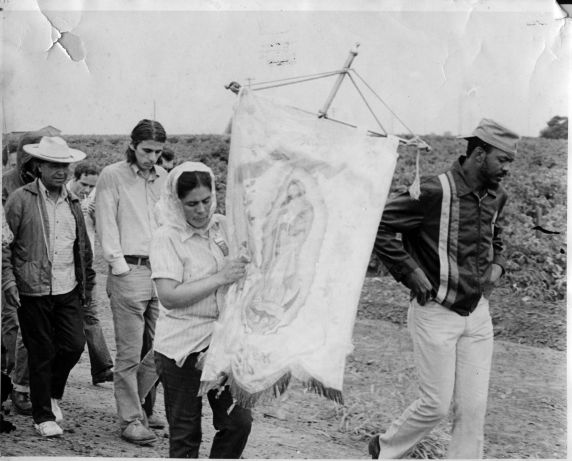
Caesar Chavez's invocation of Our Lady of Guadalupe in his organization of migrant farm workers:

Source: Wayne State Library
Pope John Paul II, then Cardinal Karol Wojtyla, leading peaceful and popular resistance to Polish Communism:

Source: nd.edu on Pinterest -- St. John Paul II's 1980 visit.
Personal aside: I love this photo's contrast between the vast crowd's vivid colors and the drab backdrop of Soviet-style housing. How many divisions does the Pope have?
Labels:
Catholic tradition,
Christian joy,
Christian witness,
devotions,
Divine Mercy,
Fatima,
John Paul II,
neither left nor right,
St. Faustina
Friday, March 31, 2017
Walking through the Desert
Stark lack of blogging activity this month and really the entire year 2017 so far. Given the variety of tasks set before me, I doubt things will improve markedly any time soon. Without asking for sympathy (others have it far worse than I) or providing a detailed list of problems, the barrenness and problematic nature of the blogged statement/response has become ever more apparent. Even if there was enough time (and there is not), the question remains: Why persist?
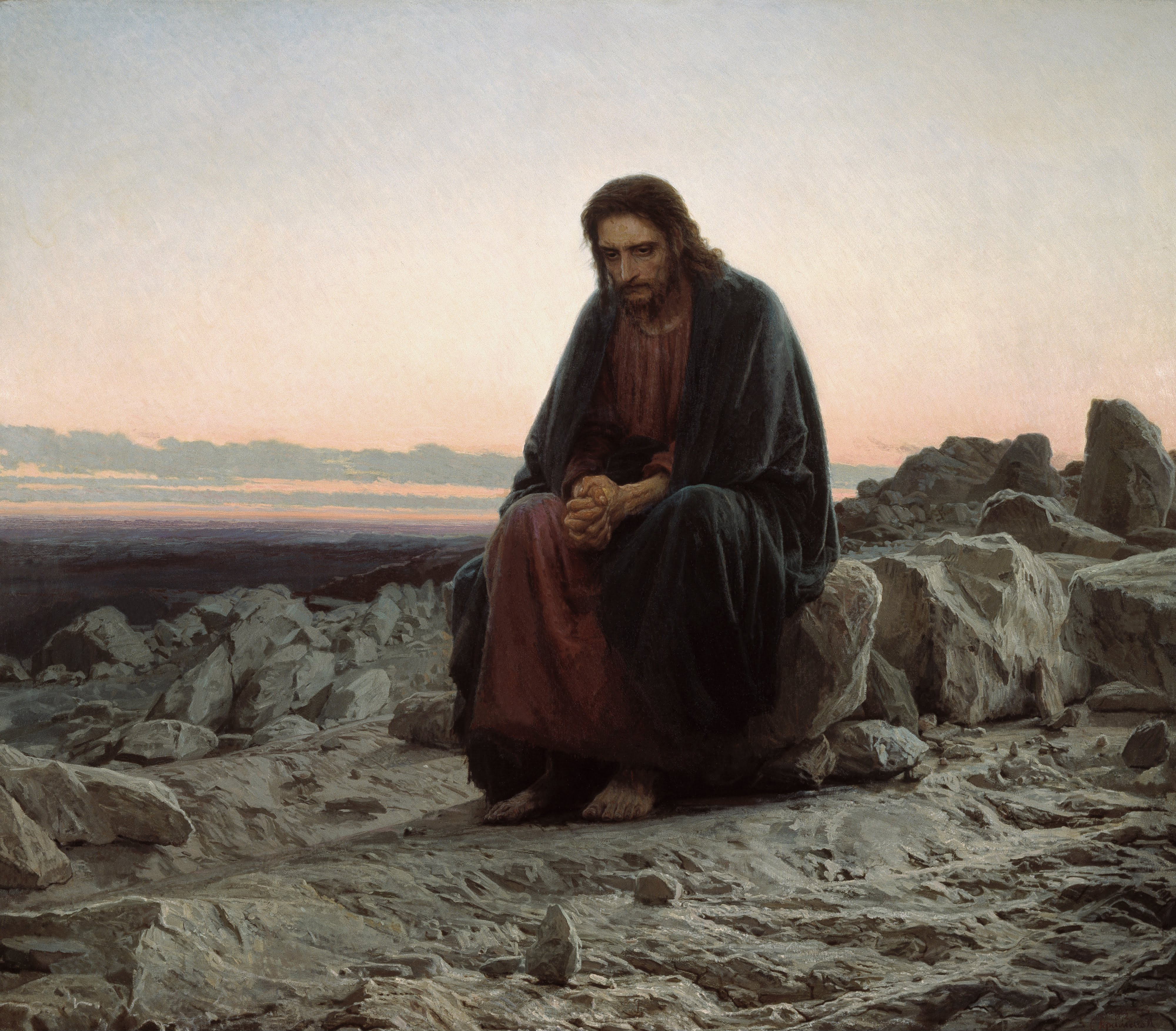
It is not for lack of material. The 2016 election, the Trump administration's first days/weeks/months, the unceasing "small war" conflict running between Pope Francis and some very vocal and conservative critics--and that's just a start. There are plenty of things to blog about. However, it has become apparent that instead of that rich banquet I am seeking a way out of the desert. Christ Himself spent forty days in the desert, only to confront temptations from Satan upon return. Only then did the angels tend his needs (Matthew 4:11).

Ivan Kramskoi, Christ in the Desert (1872); source: Wikipedia
More and more recently this is where I find my own life: the desert--and wondering about what is to come. And who knows? The burdens faced today might seem light by comparison tomorrow. A good friend and mentor reminded me last summer that before resurrection we must experience the cross and then the tomb. So, really, only God knows what will happen, but I do know that I need to reconfigure my priorities. This blog, like many other nice things in my life, has become part of that load one needs to lighten in order to cross the desert. I hope to add a post or two every month, but probably no more.
I ask for your prayers and will remember you in mine. Meanwhile, here is yet another crisp, ringing video by the evangelization master, Bishop Robert Barron.
May we stay off the Schleiermacher autobahn and remained focused on Christ. Only with and through Him shall we see new life.
Friday, March 3, 2017
Self-Immolation 2017-style

So a recent post here discussed alt-right gay celeb Milo Yiannapoulos and his unhidden Catholicism. Well, beware the riches of fame--they come with a price. In a few short days (February 20 & 21), Milo self-imploded. An old video (the existence of which, apparently, was known) reemerged on YouTube wherein Yiannapoulos 1) bragged about being sexually abused by a Catholic priest sharpened his own skills as a gay lover; and 2) extolled the virtues of intergenerational sex between older men and younger (i.e., early teenage) boys.
source: Giphy
As one might imagine, the reaction was swift and extreme. Within hours Milo had lost a prominent book deal, a prime-time speaking engagement at CPAC, and eventually his job at tech editor at Breitbart, the well-known right-wing alt-news outlet.
Then the fun really started.
Basically, the Catholic social media universe went nuts. Prominent Catholic blogger-writers such as Mark Shea, Simcha Fischer, and Scott Eric Alt denounced Milo's statements and initial coy refusal to retract any of it.
And then, as if on cue, the Catholic Milo-defenders sprang up. Yes, Milo said some awful things but, since he's Catholic, we must defend him. Or, "the Left hates Milo so we must love and protect Milo."
Shea, Alt, and Fisher, of course, were having none of it.
This British writer pulls back the curtain on the entire Milo entourage, a scary world run by straight white males scarcely out of their teens. And then they meet real, violent resistance...and soil their shorts. It is a wince-inducing read--but a necessary one.
The entire conflagration blew up at the right time: just before Lent. The Stream asks the perennial question: Had conservatives sought the world's riches, personified by Milo's gay bombast, at the expense of their souls? And the honest answer is, well, YES. A free society, the author reminds us, is a good one first. Author Joshua Charles:
And in blindly accepting Milo, or another other earthly savior, conservatives eschewed the good for the hard-hitting and powerful. A house built on sand...
To survive the Trump presidency--or any other secular political reign/regime--requires the Gospel and thus the Church. Both St. John Paul II and Benedict XVI described a Roman Catholic "communion ecclesiology" wherein the bonds of community, seen precisely in the Eucharist, provide the sure pathway to and with Christ. Chasing after the latest dumpster fire--Milo or anybody else--might provide a sugar-rush, but just as surely there will follow a disastrous crash.
Conservatism that abandons, explicitly or implicitly, the idea that virtue is necessary, not optional, for a free society, is conservatism that has lost its way and ceased to be conservative. Conservatives who maintain that “moral chains” are not all that important so long as they get in the way of temporary “winning” are not conservatives, but anti-conservatives. They know not what they do. They have forgotten that one can gain the whole world, and yet lose one’s soul.
And in blindly accepting Milo, or another other earthly savior, conservatives eschewed the good for the hard-hitting and powerful. A house built on sand...
To survive the Trump presidency--or any other secular political reign/regime--requires the Gospel and thus the Church. Both St. John Paul II and Benedict XVI described a Roman Catholic "communion ecclesiology" wherein the bonds of community, seen precisely in the Eucharist, provide the sure pathway to and with Christ. Chasing after the latest dumpster fire--Milo or anybody else--might provide a sugar-rush, but just as surely there will follow a disastrous crash.
Labels:
American culture,
communion ecclesiology,
neither left nor right,
political/theological spectrum,
politics
Adjunct Faculty & Catholic Identity: the hidden connections
American higher education's adjunct dilemma is well-known. Colleges and universities, facing the very real financial bottom-line, hire adjunct faculty to expand instruction. Thus more courses are available to students. What could be wrong with that?
Well, lots, actually.
There's a justice issue: adjunct faculty provide more than fifty percent of all instruction in American higher education yet receive exponentially less pay and benefits. The increased profit margin--get the same instruction for far less money--insures institutions will not break their reliance on adjuncts easily or willingly. See, for example, this satire here. Let's be clear: sometimes the line dividing full-time from adjunct faculty does involve ability. Faculty searches are structured, supposedly, to return the best qualified candidate given the institution's parameters. So, even when institutions seek to fill faculty lines according to categories like race/class/gender, the faculty search is supposed to result in the hiring of the best-qualified person fitting those parameters. That is an important issue. It is also important, I think, to acknowledge that institutional bias--where'd you get your degree?--and perspective bias--do you think like us?--exert real influence on faculty searches. Not every single one, obviously, but those factors do exist.
Students do not benefit, either. As reliance on adjunct increases, first-year students take increasingly more courses with adjunct faculty. Full-time faculty--the ones who've made it through the extended hiring process--actually teach fewer students. More and more, adjunct faculty are the first "teachers" students see, and this experience occurs precisely in the foundational courses institutions and major-granting department insist are so important. In other words, precisely where and when students need quality instruction, they are least likely to obtain it. The result of all this is that student retention sags.
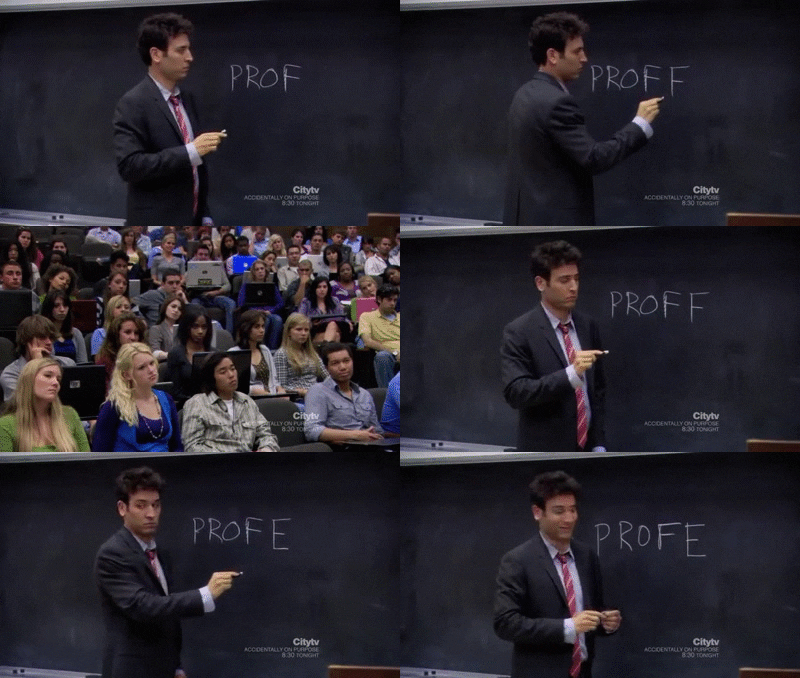
Why keep taking classes when they're all like this?

source: Giphy
I have taught long enough to know that could be anybody, full-time tenure-track or adjunct faculty. But the student array--all jammed into an anonymous lecture hall, wondering what the point is--is quite accurate.
Friday, February 3, 2017
TFW Rogue One Reminds You of Silence
TFW--That Feel When...
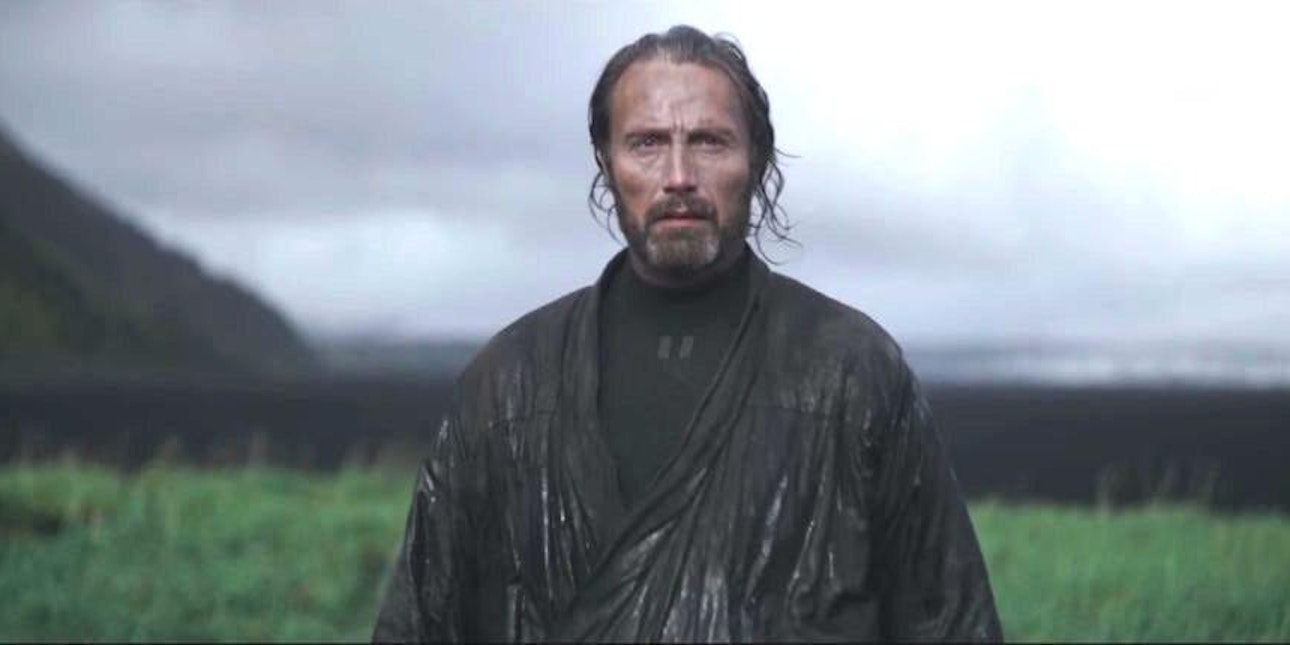
No, really, when watching Rogue One with my kids recently I recognized a connection with Silence:
Galen Erso and
Father Rodrigues face the same dilemma:
How do you resist silently?
Answer: They respond differently. Galen actually does something. Depending on the book or the movie, Rodrigues does little or nothing. But at the moment of decision, they face the same demoralizing, annihilating reality: they can resist immediately and surely suffer, or they can submit outwardly and seek another avenue of resistance.

Alt-Right Bête Noire Milo Yiannopoulos is an Aquinas-quoting Catholic
Recent post by Artur Rosman wherein he demonstrates the nuclear option--or maybe napalm option is more accurate/appropriate--in Catholic Studies.
So the familiar term "bad Catholic"? Rosman blows up what that mean and to whom that might apply. Hence "nuclear/napalm". Rosman is willing to advance that uncomfortable, wince-inducing argument that many intuit but often aren't willing to recognize.

Source: Jason Abbruzzese on Mashable from 2015.
Recent post by Artur Rosman wherein he demonstrates the nuclear option--or maybe napalm option is more accurate/appropriate--in Catholic Studies.
So the familiar term "bad Catholic"? Rosman blows up what that mean and to whom that might apply. Hence "nuclear/napalm". Rosman is willing to advance that uncomfortable, wince-inducing argument that many intuit but often aren't willing to recognize.
Source: Jason Abbruzzese on Mashable from 2015.
Tuesday, January 31, 2017
Silence & The Rigors of Witness
Well, I finally watched Scorcese's Silence. So, as promised earlier, here is the second installment of reflections.
Adam Driver (Garupe) and Andrew Garfield (Rodrigues) in Silence; photo from AZ Central
First, visually it's a wonderful, lush movie.
Rodrigo Prieto deserves all the praise he's received for his cinematography. Sweeping vistas, crashing surf, nuanced colors and lighting--they're all here. It makes sense that a "Catholic" movie would appear visually attractive. We have St. Peter's Basilica, the pomp and ritual of the Mass everywhere, every day. So a movie about Catholics should follow suit, and Silence does not disappoint. For example, the starkly difficult choice Rodrigues faces are offset by several shots where fog and/or mist obscure the view. The issues are not clear, the notion of Japan as a swamp where foreign faiths go to die, are embodied by the swirling mists in and out of which the characters move.On this note, the cinematography's beauty stems from scenes shot up and across--valleys, ocean beaches, steamy rainforests, etc. Part of the movie's difficult subject gets embodied, though, by the shots downward. Mucky, sticky, omnipresent mud grounds the movie. (A hint of this comes from the YouTube icon linked below.) So, head in the cloud and feet stuck firmly in a foot of gluey mud--this is the movie Silence.
Which is right where any authentically Catholic movie about Japanese missions should be.
Saturday, January 28, 2017
connections reminder
Do the episodic postings of this blog get you down? Looking for other connections to the Spiritual Diabetes discussions?
Google + here. Yes, Google+; laugh all you want, but that platform provides connections and conversations not found elsewhere.
One of these days Tumblr and/or Instagram, but before then there's a book manuscript to finish (alluded to here). Which explains in part why the postings lately here have been fewer and further between.
Thursday, January 12, 2017
Agonizing Beauty
Reflections on Scorese's Silence, part I
Warning: Spoilers follow.
This will be the first of two posts on Martin Scorcese's Silence, a movie long-in-the-making version of Shusaku Endo's 1966 novel. The second post will appear once I see the movie. So what follows is a discussion of the novel and what some critics have made of the movie. Here is a good overview of the movie and its content.
First, as expected from a talented director like Scorcese, the movie's visuals are stunning. After extensive success in Japan, Christianity found itself ruthlessly outlawed and persecuted in the seventeenth century. The movie follows two young Jesuit missionary priests who, hearing that their mentor has apostostasized, travel to Japan to confirm the rumors.
Part of the shoguns' torture juxtaposed excruciating pain with the simplest, and pain-free, gesture. All arrested Christians were given the opportunity to apostasize by stepping barefoot on an image of Jesus (hence the fumie, literally "the stepping-on image").
Come on--what could be easier than that?
Labels:
martyrdom,
religion & culture,
Scorcese,
Silence the Movie,
theodicy
Thursday, December 22, 2016
Meanwhile, slowly dissolving...
So everybody's down on 2016: all the celebrities who have died, the Cubs won the World Series, and then there's that election thing.
But what really should be worrying us is the gradually expanding sense of despair, one that culminates in early death and suicide. It's hitting middle-aged white women particularly hard. Regional and socio-economic factors contribute, but one thing is clear: the communal web or network that used to hold together communities has frayed and is snapping. The individualizing age of the smartphone has shown its downside--and therein people suffer, well, individually, i.e., alone. Hence suicide becomes not possible but perhaps preferable. From the article Jennifer Silva, a sociologist from Bucknell University:
Read more here.
But what really should be worrying us is the gradually expanding sense of despair, one that culminates in early death and suicide. It's hitting middle-aged white women particularly hard. Regional and socio-economic factors contribute, but one thing is clear: the communal web or network that used to hold together communities has frayed and is snapping. The individualizing age of the smartphone has shown its downside--and therein people suffer, well, individually, i.e., alone. Hence suicide becomes not possible but perhaps preferable. From the article Jennifer Silva, a sociologist from Bucknell University:
"People are trying to solve the crisis on their own. I see a lot of relying on the internet to try to treat, especially mental health problems. I had an older white woman who was suffering from self-diagnosed depression, but a few years later I learned she actually died of a brain tumour but she never went to a doctor because she couldn't afford it.
"[These people] are often not working, not in relationships, just not connected to any kind of social organisations. In this coal region there used to be a church on every corner and people would join together and socialise and exchange information, but now, most of those churches have closed down.
"We have a whole generation of people who are just in some ways wasted talent. There's a lot of suffering, a lot of desperation, fear, vulnerability, and hopelessness. They're not really sure how they can make a world better for their children and they feel very betrayed."
Read more here.
Labels:
gender,
neither left nor right,
suicide,
Theology of the Body
Subscribe to:
Posts (Atom)