Friday, October 23, 2015

Can we pleez stahp?

Liberal education:  have the kids take classes in a variety of fields, encouraging them throughout to drink deeply from the traditions in each discipline, push the boundaries of those traditions, and seek their intersections.  Thus the students become learned, truly educated citizens who in addition to training in particular disciplines (Psychology, Education, Business, the arts, etc.) possess broad familiarity in other disciplines (the arts, religion, politics, etc.).

And the telos--the end towards which all this energy and study is directed--is that these learned individuals will go into the world, go their various ways, pursue various careers, meet with various levels of success, and yet maintain an understanding and appreciation of humane learning--that which makes us human.  The arts--visual and performative, politics, contemporary trends, historical awareness, FOOD, for that matter, and yes even religion.

So the first question;  what should the kids read?

The second question stems from this first:  Do they need to read that?

It turns out Duke University required its 2015 freshmen class to read Alison Bechdel's Fun Home:  A Family Tragicomedy.  As expected, some students protested, calling it pornographic.  As also might be expected, others leapt to defend Duke's required reading.  It's not pornographic, the students protesting are just close-minded, precisely the people who needs their minds opened by such reading.  Thus, an impasse.

So what's the hubbub about?  From Amazon.com, the Publishers Weekly review:
This autobiography by the author of the long-running strip, Dykes to Watch Out For, deals with her childhood with a closeted gay father, who was an English teacher and proprietor of the local funeral parlor (the former allowed him access to teen boys).Fun Home refers both to the funeral parlor, where he put makeup on the corpses and arranged the flowers, and the family's meticulously restored gothic revival house, filled with gilt and lace, where he liked to imagine himself a 19th-century aristocrat. The art has greater depth and sophistication that Dykes; Bechdel's talent for intimacy and banter gains gravitas when used to describe a family in which a man's secrets make his wife a tired husk and overshadow his daughter's burgeoning womanhood and homosexuality. His court trial over his dealings with a young boy pushes aside the importance of her early teen years. Her coming out is pushed aside by his death, probably a suicide. The recursively told story, which revisits the sites of tragic desperation again and again, hits notes that resemble Jeanette Winterson at her best. Bechdel presents her childhood as a "still life with children" that her father created, and meditates on how prolonged untruth can become its own reality. She's made a story that's quiet, dignified and not easy to put down. 

Reproduced here without any claim to ownership.

So let's get this "straight" (bad pun, I realize):  Duke University, one of the nation's premier private education institutions, required its entire in-coming first year class (approximately 1600 students) to read a lesbian's memoir of her funeral-parlor-operating, closeted homosexual father.  Quite frankly, instead of decrying "pornography!" the students instead should have questioned the relevance of having to read this at all.


Monday, September 28, 2015

Goal & Path//Charity & Pope Francis

Here's my latest piece at the St. Joseph's College of Maine Theology blog.  Yesterday was the feast of St. Vincent de Paul, a fitting saint for Pope Francis' U.S. visit.  What days in which we live!  So much attention paid to Pope Francis' every move and sentence, and really I bet he himself would tell us to focus ourselves on serving our neighbors.  Today's readings at Mass really underlined the importance of charity, too.  We need these reminders.  Otherwise we become like the rich chided and warned by St. James.  At the end of the Gospel today one of my daughters whispered:  "That's really creepy.  How come they never read that part at school mass?"  Especially since the Gospel yesterday also involves Jesus' injunction to receive children, we often overlook the ways in which we attempt to keep the Good News at a child's, not an adult's, level.  The call to charity, while certainly involving children, focuses on adults because in its the adult world where charity really gains traction.  And challenges us to ever greater charity.

Tuesday, September 22, 2015

Holiness is Achievable – 3 Day Quote Challenge

It seems that my good friend and blogging guru, Virginia Lieto, has thrown down the gauntlet.  I have been named in a three-day quote challenge.  From Virginia (who was in turned named by Melanie Juneau):

The rules of this challenge:

  1. Post one quotation a day for three days (they can be from other sources or one of your own).
  2. Nominate 3 other bloggers to participate per post.
  3. Thank the blogger who nominated you.

So, to cover all the bases, thanks first to Virginia for her kindness to include in the spirit of friendly competition and the great apostolic work of Catholic blogging.  This is, folks, the era of the New Catholic Renaissance. If you're reading this, were redirected here, and when you follow a link to another Catholic blogger, then, y'all, you are participating in the New Catholic Renaissance. It has many voices, themes, designs, and goals--but they all contribute to uplifting of Christ's Church.  And Virginia contributes remarkably to this.  (And, hey, Bishop Robert Barron has announced as much, on NPR no less, so there you go--the New Catholic Renaissance.)

And my three companions in Catholic blogging quote-dom are:  

*Michael Seagriff, my fellow upstater
*Nathan Barontini, one of my go-to +Google Catholic apologists

First day's quote....from a confessor who recommended this and I found it, while of course quite familiar, remarkably refreshing:  The Magnificat:

The Prayer Of Mary 
My soul proclaims the greatness of the Lord,
my spirit rejoices in God my Savior
for he has looked with favor on his lowly servant.
From this day all generations will call me blessed:
the Almighty has done great things for me,
and holy is his Name.

He has mercy on those who fear him
in every generation.
He has shown the strength of his arm,
he has scattered the proud in their conceit.

He has cast down the mighty from their thrones,
and has lifted up the lowly.
He has filled the hungry with good things,
and the rich he has sent away empty.

He has come to the help of his servant Israel
for he remembered his promise of mercy,
the promise he made to our fathers,
to Abraham and his children forever.

(Lk 1:46-55)

Magnificat anima mea Dominum;
Et exultavit spiritus meus in Deo salutari meo,
Quia respexit humilitatem ancillae suae; ecce enim ex hoc beatam me dicent omnes generationes.
Quia fecit mihi magna qui potens est, et sanctum nomen ejus, Et misericordia ejus a progenie in progenies timentibus eum.
Fecit potentiam brachio suo;
Dispersit superbos mente cordis sui.
Deposuit potentes de sede, et exaltavit humiles.
Esurientes implevit bonis, et divites dimisit inanes.
Sucepit Israel, puerum suum, recordatus misericordiae suae, Sicut locutus est ad patres nostros, Abraham et semeni ejus in saecula.


So much good there--to contemplate and remember.  God's ways are not always our own. We do well to remember the power and mystery--and the love!--of God.

And then there's this:


News Hits the Street

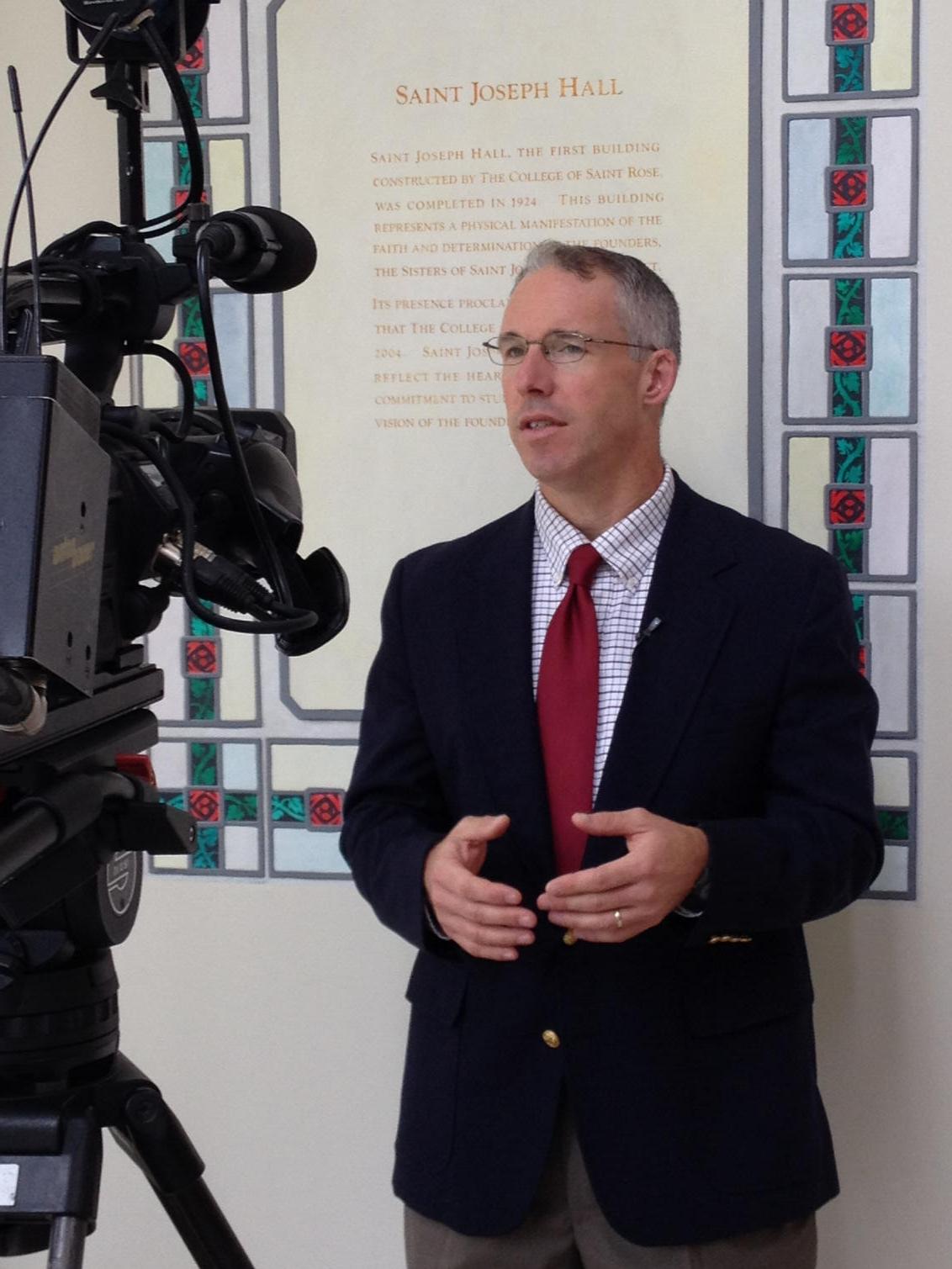
Your earnest blogger has made a couple Albany-area appearances regarding Pope Francis' visit to Cuba and the US.

A phone interview with WAMC 90.3 FM, the area's powerful NPR affiliate

And television interviews with:

WNYT channel 13, Albany's NBC affiliate

and

WRGB CBS 6 (one of the nation's oldest television stations, by the way;  based in Schenectady, NY, one-time home base for General Electric).

And best of all, an interview with The Chronicle, the Saint Rose student newspaper!


Photo from @CollegeofStRose 


Friday, September 18, 2015

Spiritual decay by any other name

...is still spiritual decay.  We lose what we once were.

This might be human nature, not merely a jeremiad of cultural decay.  The so-called good ol' days contained violence, racism, ethnic hatred, and oppression, too.  And before them, the same.  Things fall apart.  Critics like to bag St. Augustine of Hippo and Augustinianism for gloomy dispositions and low expectations about human improvement, but hey, the guy and those who follow in his intellectual wake have a point:  we tend to muck things up.

That's where this blog piece by Dominican brother Paul Clarke, OP, makes a great contribution.  Among the many things Pope Francis' Laudato Si' indicts stands indifference.  We simply don't understand and feel the pain others experience.  Clarke:

The indifference that Francis is taking aim at is a kind of spiritual leprosy, a problem with our nerve endings where the concerns and pain of others fail to register. We need to feel pain if we are to avoid severely injuring ourselves. If I put my hand on a hot stove, it’s the searing pain that will make me (a) scream like a banshee as I (b) pull my hand away. The harm done is actually the burning skin on my hand, but without the pain, I might have left it there to char. That’s basically what’s so dangerous about neurological disorders that make you insensitive to pain (basically, imagine leprosy). For a hodge-podge of reasons that are cultural, historical, political, personal, and spiritual, we have a moral equivalent of leprosy. Where the suffering of others should cause us pain, we just don’t feel it.

Bingo.  Clarke's argument gets at this blog's title and inspiring notion--spiritual diabetes--through another, related, metaphor.  Both diabetes and leprosy involve rot;  one's internal and the other external.  Make no mistake, though, things decay in either situation and, Clarke makes a great point here, one of the significant and first results is...indifference.  We don't "feel" as we should or used to.  Healing starts with recognizing the interconnectedness of things--of life itself.  Clarke:

Laudato Si’ is an effort to integrate the splintered moral narratives into a single, spiritual frame, a dramatic portrait of reality in which the central character of the story is us. Pope Francis contests the logic of a “piecemeal” approach which treats man’s relationship with the earth as a series of discrete problems. Like Pope Benedict XVI, he points out that “the world cannot be analyzed by isolating only one of its aspects, since ‘the book of nature is one and indivisible,’ and includes the environment, life, sexuality, the family, social relations, and so forth” (§6).

Diet and exercise.  And the Theology of the Body.  We have bodies--from God!--and what we do with them matters, and we can learn to act correctly when, as Clarke reads Pope Francis (and thus his predecessors St. John Paul II and Benedict XVI), begin with an appreciation for interconnectedness.  What we put into our bodies and how we remain active (diet and exercise) are more than just physical practices;  they provide an avenue for understanding how to combat a very real spiritual pandemic: indifference.

Brother Clarke's piece is just one (the third) in a five-part series on Pope Francis' Laudato Si' in honor of the Pope's US visit next week.  Read it all here at the Dominicans' theology blog Dominicana.