Wednesday, October 5, 2016

That Ain't What The Word Means

Shaking off the dust on this blog.  My apologies for the lack of output;  it's been a very busy time.

And right when all the great blogging issues come before us:  the election, baseball postseason, Pope Francis' in-air press conferences, football, the start of a new semester...

All of that will receive due consideration.  This Wall Street Journal op-ed by William McGurn, though, merits a quicker response.  Mainly because it lays out clearly, that for all the reasons why Donald Trump is not a fit candidate--let alone acceptable choice--for the Presidency, and all the reasons casting doubt on Hillary Clinton's candidacy, one of the real problems is actually Virginia Senator Tim Caine, Clinton's vice-presidential candidate.  Look up "devastating take-down" and you'll find this post.

McGurn:
When he walks onstage Tuesday night for this year’s vice-presidential debate, the junior senator from Virginia will carry with him a résumé that shouts respectability. ...
In sum, Mr. Kaine is a garden variety Catholic Democrat of the early 21st century. In this capacity, the orthodoxies that now define his party and might once have disturbed a practicing Catholic bother him not at all. These include abortion on demand, underwritten with taxpayer dollars.
In some ways Mr. Kaine’s rise represents the yielding of the old pro-choice Catholic Democrat represented by Mario Cuomo—“I am not implying that we should stand by and pretend indifference to whether a woman takes a pregnancy to its conclusion or aborts it” said he at Notre Dame in 1984—to the brave new world where son Andrew Cuomo says that those who oppose abortion “have no place in the state of New York.” Whatever else this is, it marks a comedown from the high hopes of liberal American Catholicism in those heady days before JFK became the first Catholic president.
We have heard this before.  Kaine embodies the "Cafeteria Catholic" approach so loved in America:  I'll have some of that liturgy, a big serving of spirituality, a sprinkling of Mary, but no thanks, none of that pro-life stuff.  I'm trying to cut back.  All the while Kaine touts his "Catholic" identity.  To which McGurn and everybody else responds:

Tuesday, September 20, 2016

Studying History Gets Messy

And maybe that's all right.  The problem is that we need to keep digging into our own pasts--individual and collective--to (re)discover the foundations of the self and community...and how those stand themselves atop other foundations, things we did not see at the time.

For example, growing up in small Midwestern towns meant enduring poppy Rod Stewart songs like this:


Ah yes, the hair, the overproduction, the same time that produced Starship's "We Built This City," arguably the worst pop song ever.  Downtown Train captures that same time; saccharine tunes song by aging rock stars.  This is why we listened to Def Leppard and Motley Crue.

Then lo, while digging around Bruce Springsteen songs I discovered.... "Downtown Train" by its original creator, gravel-voiced Tom Waits.  Listen and prepare to be shocked.


Those who listened to music like Waits', of course, already knew this...but that's not the point.  They're not "right" so much as the neatly-packaged Stewart remake aptly suited the slick, overproduced 80s decade in which it appeared.  Waits' original harkens to an earlier, edgier time, and certainly a rougher experience of urban America.  Waits fans will probably balk at that, wanting some thing deeper, but that's enough...at least for now.

There are other examples that could be discussed here, but the point is that studying history, even when it's the history of Christianity, can lead to similar discoveries of the rougher, edgier Church.  One course this semester is doing just that and is just now running aground of the great Christological debates from Nicea to Chalcedon as well as the great martyrologies prior to Constantine's conversion.  For unreflective undergraduates or naively devout evangelical Protestants this history--rooted as it is in real places and real people--presents some messy, unavoidable realities. The slick, easy, saccharine story they've been fed previously about Jesus, Christianity, and the Church simply does not hold up to the historical record. I know about this because, as blogged here over the past four years, I went through roughly the same experience.  So hopefully they will enjoy a resurrection of sorts in the semester, witnessing how the Gospel spread throughout the world, formulating the foundations of Christian belief as it went.

Monday, August 15, 2016

Push in the Right Direction

Today is the Feast of the Assumption of the Blessed Virgin Mary, a day commemorated by entering religious orders (and anniversaries thereof) and a round of Marian piety in the Catholic social media universe. The Gospel today features the Magnificat, a wonderful prayer in its own right, and today a reminder of the personal particularity through which the Christian faith comes.  


And Mary said:

“My soul proclaims the greatness of the Lord;
my spirit rejoices in God my Savior
for he has looked with favor on his lowly servant.
From this day all generations will call me blessed:
the Almighty has done great things for me
and holy is his Name.
He has mercy on those who fear him
in every generation.
He has shown the strength of his arm,
and has scattered the proud in their conceit.
He has cast down the mighty from their thrones,
and has lifted up the lowly.
He has filled the hungry with good things,
and the rich he has sent away empty.
He has come to the help of his servant Israel
for he has remembered his promise of mercy,
the promise he made to our fathers,
to Abraham and his children forever.”

Through Mary God accomplished the salvation of the world.  And through Mary the Christian tradition's penchant for antitriumphalism and unmerited grace see its first and greatest exemplar.  The Marian charism, especially with Pope Francis' support, will remain a revitalizing force within the Church.

Wednesday, August 3, 2016

backing off...a cliff


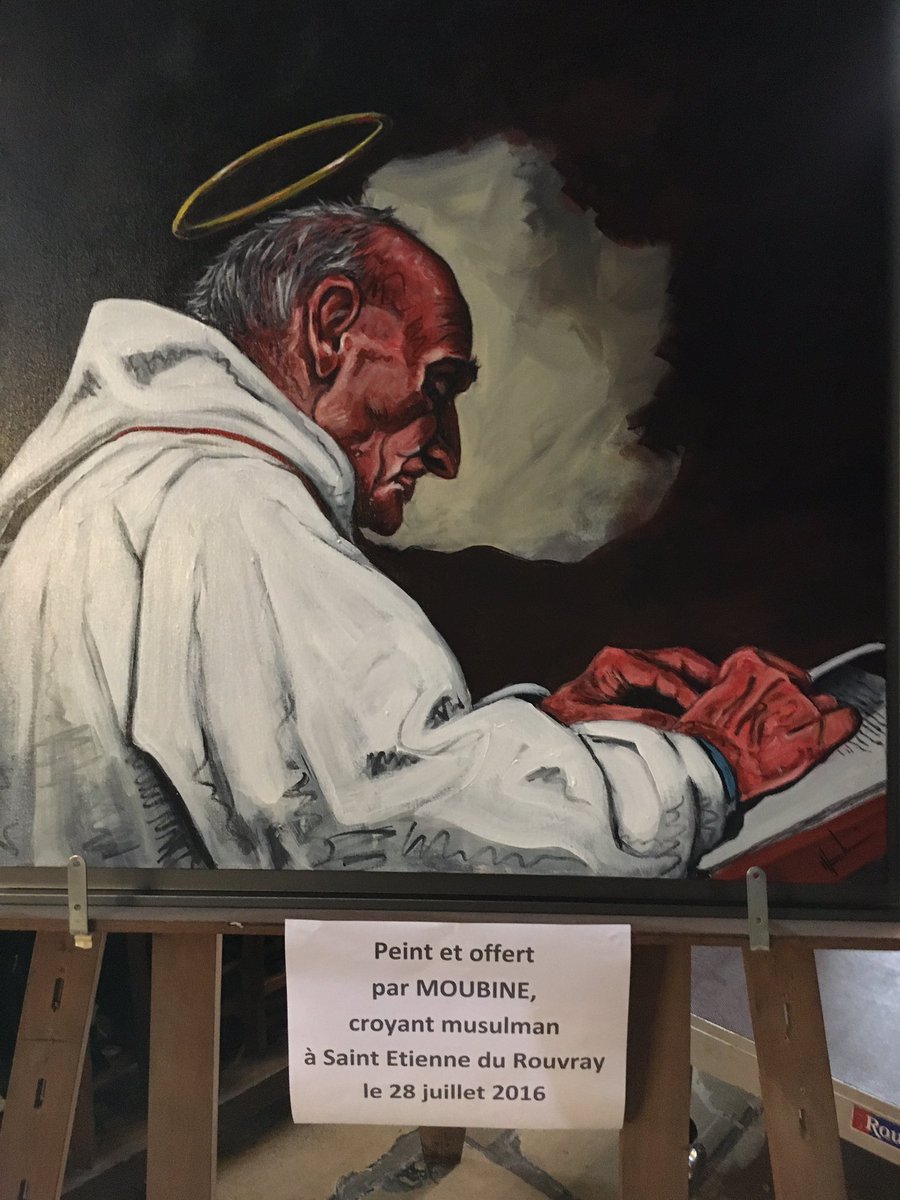
While saying Mass late last month, Father Jacques Hamel was murdered by two jihadists.  And already some of the Catholic world wants to, whoa, pull back the reins because y'know, celebrating "martyrdom" comes too close to the jihadists themselves.


Allen Jacobs:
But worse than the incoherence is this: the question of whether Fr. Hamel isgenuinely a martyr is one that Vallely desperately wishes to avoid. For him, the Church is not to acknowledge its martyrs unless such acknowledgment serves what Vallely believes to be the proper political calculation of the moment. For him this is the key: “we must resist the notion that a fundamental clash of civilizations is the issue.” Nothing can be done that stands a chance of feeding a political narrative which Vallely finds tasteless. Thus: “The real problem is the pathology of a perverse minority of extremists with distorted notions of holy war and martyrdom.” Ah yes, the real problem at last! This is moral equivalence at its most loathsome: those who would seek Fr. Hamel’s canonization are morally indistinguishable from his murderers, because both belong to that “perverse minority of extremists with distorted notions of … martyrdom.”
So let not the Church call its martyrs martyrs, lest by doing so she fall into “extremism.” Let not the ancient commitment to honor the martyrs of Christ get in the way of political convenience. 

Read all of Jacobs' criticism here.

Jacobs is exactly right here and, ya' gotta admit it, part of this reticence he targets comes from the Catholic tradition itself. Or at least an interpretation of the tradition.

It's also, and this is where, if not already, I lose friends on the Left, part of the New York Times worldview:  one where moral individualism reigns supreme and any claim that restricts or denies that is anathema. Furthermore, the NYT appreciates culture and learning, but only insofar as they uphold the a priori moral individualism.  So something as grotesque and bloodily real as "martrydom"--by anybody--must be held at arm's length.  It's easy to do this with ISIS-martyrs, but when Roman Catholic Christianity--that tradition from which the ersatz NYT worldview itself grows (and from which it, the NYT, has long since severed itself)--then distinctions and clarifications must be made.  The last thing the NYT wants is for any of its oh-so-smart readers to be challenged....by something other than itself.  If the NYT itself challenges, well, that's fine.  But gads, not that Catholicism stuff...again.

And throughout that little rant you probably could substitute "liberal middle-to-upper class and their progressive friends." This worldview encompasses most of liberal mainstream Protestantism and not a few swaths of liberal American Catholics.  This group still insists that "embracing the world" requires first bracketing one's own beliefs.  So, if we're confronted with ISIS and we want their religiously-infused violence to stop (a worthy desire!), then, in this worldview, we throttle back first on our own views.  With Father Hamel, that means toning down all this martrydom stuff.

There are many responses ("You're just plain wrong" comes to mind), but Karl Barth has a good one:

THE BEST APOLOGETIC IS A GOOD DOGMATIC.

There, that wasn't so hard, was it?  Instead of backing up, start first with statement of belief, a credo.  Then, as William Placher wrote in 1989, proceed unapologetically. Stop seeking prolegomena;  you'll never find a universal common ground that includes virtually everybody.  Proceed instead with the Church's beliefs and the given issue at the time.  In doing so you won't insult your dialogue partner, either.  Let's be honest, ISIS' notion of "dialogue" is "convert to Islam." That's just as unhelpful as the NYT worldview.  For example, one of best known images of Father Hamel (seen above) came from a Muslim artist in France.  Hey, that's real interreligious dialogue; the recognition and appreciation of the other's views without sacrificing your own.  

Because if you start with an apology as so many of our cultural elites want, we'll end up with no ground on which to stand.  We'll have backed ourselves off a cliff.

Meanwhile, pray for the respose, and intercession, of Father Hamel and all holy martyrs.

Tuesday, August 2, 2016

Between Jest and Earnest: Remember When Catholics Were The "Political Proble...

Between Jest and Earnest: Remember When Catholics Were The "Political Proble...:


Great recent post by my good friend, Art Remillard from Pennsylvania's Saint Francis University.  In musing on Paul Blanshard's American Freedom and Catholic Power (1949), Remillard traces the ascendency of American Catholicism's rise over narrow-minded concerns.  Powers which, Remillard notes, wielded considerable political and social power (e.g., Norman Vincent Peale).


And it turns out the lesson has been short-lived. Nowadays some American Catholic leaders espouse views that appear identical to what was once voiced against Catholicism itself.  Thus Remillard:


But one thing is for sure: Catholics have changed the face of America. And America has changed Catholicism too, by, among other things, giving some among them a very short memory.

That's a powerful conclusion, and he is not wrong.  This is, in part, why the 1960s saw counter-cultural Catholic celebrities like Dorothy Day and Thomas Merton emerge (something Remillard notes and which, by the time it happened, indicated that "the moment" had actually already passed).  Although he does not state it, I do think Remillard's point about short Catholic memories could be applied to other Catholic cultural situations, not just political ones.

Sunday, July 31, 2016

St. Ignatius' Heavily-Used Cookbook -or- Ignatian Reflections Part 1

Today is the Feast Day of St. Ignatius Loyola (1491-1556), one of my favorite saints and the focus of much reflection in American Catholic education. This attention surfaced as a result of Vatican II's call for religious orders to recover a sense of their roots.  In the United States, no religious order has a bigger footprint--albeit not the oldest--in Catholic higher education than the Society of Jesus.  Thus this year starts off what hopefully will be an annual tradition of Ignatian reflections on the spiritual sub-universe within Roman Catholicism that is "the Jesuit tradition."  With that in mind, here's my first take, my latest at the St. Joseph's Theology blog.  Please enjoy and share!

Saturday, July 30, 2016

Marian path to Christian Environmentalism

A recent post detailed some Trinitarian foundations for Christian environmentalism.  The very creedal profession of the Trinity--not just that we believe in God the Father, Son, and Holy Spirit--but how we state those beliefs, all of which illuminate the Trinity's creative relationships suggests a renewed appreciation for the world itself but importantly how we care for it, too.


Confession time:  that post came about through reflecting on the Creed as it kickstarts the Rosary, usually as I drove to work through the geological oddity of eastern upstate New York, Albany's Pine Bush.  Google images montage here;  lots of scrubby pines and sandy soil, much of which now lies underneath sub/urban development and, problematically, the area's largest landfill.  Still, much natural beauty lies within, as this cathedral-like trail attests.


Anyway, the point: the Trinitarian foundations for viewing the environment come to us, in this case, through the Rosary, that most Marian and Roman Catholic of prayers.

Hail Mary, full of grace,
The Lord with you.
Blessed are you among women,
and blessed is the fruit of your womb, Jesus.
Holy Mary, mother of God,
pray for us sinners now and at the hour of our death.


I suppose the easy route would be to draw an analogy between the Blessed Mother's fertility celebrated by the prayer and the fertility of the natural world itself.  While superficially helpful, such a connection might obscure deeper, more authentic and vital, relationships.  After all, the Catechism (#773) asserts that the Church's Marian charism--its interior holiness--precedes the Petrine, the external, authoritarian charism.  Keep that in mind whenever you hear complaints about Vatican intrusiveness or the Church's unwillingness to change or the old canard "I'm spiritual but not religious."  Because of Mary, the Church is spiritual before it is "religious," and so, too, is the natural world.